The Future of Experiential Tourism in Seattle (and Around the World)
People don’t remember facts.
They remember how you made them feel
There was a time when tourism was about access.
Access to a landmark. Access to a famous view. Access to a place someone had seen in a photograph.
But access is no longer rare. Information is everywhere. Images are everywhere. You can stand virtually anywhere in the world through a screen.
What cannot be digitized is how a place makes you feel. And that is where the future of experiential tourism lives. The human mind is not wired to remember lists of facts. It is wired for story. When someone tells us a story, something remarkable happens inside the brain. Neuroscientists have shown that storytelling activates multiple regions at once — language processing centers, sensory cortex, emotional pathways, even motor regions. In effect, the brain begins to simulate the experience. It lights up.
A list informs. A story immerses. That difference is everything.
For decades, many tours were built on information density. Dates, architecture, historical markers, notable names. Important, yes. Memorable? Rarely.
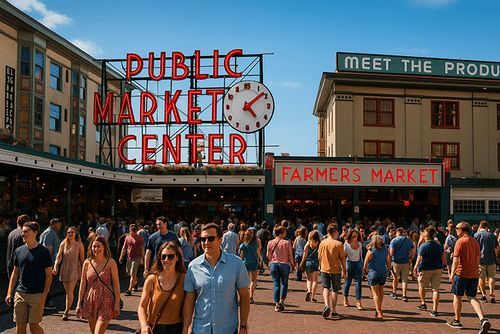
The modern traveler does not simply want to know what happened somewhere. They want to feel as if they are inside it. They want narrative tension. They want contrast. They want sensory depth. They want connection. In cities like Seattle, this shift is particularly powerful. Walk through Pike Place Market and you are already surrounded by story — the echo of fishmongers calling across the crowd, the smell of fresh coffee and warm bread, the salt air drifting in from Elliott Bay, the color and texture of flowers, neon signs, brick and glass. The city is alive with sensory cues.
But those cues alone are not enough. They must be orchestrated.
The strongest memories are rarely triggered by a single input. They are layered. A song tied to a moment can return you to it decades later. A familiar scent can unlock childhood in an instant. A shared taste, framed within a meaningful story, can anchor itself deeply in long-term memory. When sight, sound, taste, and smell are aligned with narrative, something more permanent is formed.
This is not accidental. It is design.
In experiential tourism, the future belongs to those who understand how to “stack the deck.” To align the senses intentionally. To use music at the right moment, not as background noise but as emotional architecture. To introduce a flavor at the precise point in a story when the mind is most receptive. To leverage color, lighting, movement, and even pacing as psychological tools rather than aesthetic afterthoughts.
When these elements converge, a tour stops being a sequence of stops. It becomes an imprint.
I often think of these as “Souvenir Moments” — not something you buy in a gift shop, but something you carry away internally. A shared toast that lands at the climax of a narrative. A perfectly timed piece of music as a group steps into a new space. The smell of roasted coffee layered into the story of a city’s early ambition. The collective energy of strangers who, for a brief time, feel like participants instead of observers.
Those moments endure because they activate more of the brain than information ever could.
Seattle is uniquely positioned for this era. It is compact, walkable, layered with maritime history and culinary innovation, fueled by a steady stream of cruise passengers seeking meaningful connection in limited time. Around the world, similar dynamics are unfolding. Travelers increasingly choose depth over volume. One unforgettable experience over five forgettable ones.
Premium experiences are rising not because they are more expensive, but because they are more intentional. Smaller groups allow for tighter emotional arcs. Curated tastings allow for sensory alignment. Skilled hosts guide not just the body through space, but the mind through narrative.
The role of the tour guide is evolving as well. The future is not the script reader reciting memorized paragraphs. It is the experience host who understands pacing, tension, and release. Someone who knows that a pause can be more powerful than a paragraph. Someone who senses when to raise energy and when to quiet a crowd so a moment can breathe.
Technology will continue to advance. Artificial intelligence, augmented reality, dynamic pricing systems — these will shape operations and personalization. But technology cannot replace the human experience of story shared in physical space. It cannot replicate the electricity of collective laughter or the quiet intensity of a well-delivered reveal.
The companies that lead in the coming decade will not be those who simply move people efficiently from point A to point B. They will be those who understand how the mind works. Those who design for emotion. Those who treat music, smell, flavor, color, and narrative as instruments in the same orchestra.
Because in the end, people do not remember itineraries.
They remember how they felt when the music swelled.
They remember the smell in the air.
They remember the taste that accompanied the story.
They remember the moment they felt part of something.
That is the future of experiential tourism in Seattle and around the world.
Not more information.
More meaning.
And meaning is built through story.